
When we imagine Japan, we picture endless green rice paddies, Shinto shrines, and a society built on consensus and order. But for thousands of years, Japan was none of these things. It was a wild, forested land inhabited by the Jomon—bearded hunter-gatherers who made pottery and lived off the bounty of nature.
Then, around 3,000 years ago, everything changed.
A new people arrived from across the sea. They brought with them the secrets of wet-rice cultivation, the power of bronze and iron, and a genetic signature that would sweep across the archipelago, fundamentally rewriting the biological history of Japan.
These were the Yayoi people.
They are the architects of modern Japan. While the Jomon gave Japan its soul and its indigenous foundation, the Yayoi ancestry provided its backbone. Today, the vast majority of the modern Japanese genome comes not from the ancient hunters, but from these continental farmers.
But who were they? Were they refugees, conquerors, or pioneers? And does their bloodline flow through you?
Thanks to advances in paleogenetics and Nexogeno Results, we can now separate these ancient layers. By performing a dna raw data upload, you can peel back the centuries to see if your DNA aligns with the rice farmers who built a civilization.
In this article, we will explore the origins of this ancient group, their connection to the Yellow River civilizations, and answer the complex questions regarding their relationship with modern Koreans and Chinese.
1. The Arrival: Where Did the Yayoi Live?
The Yayoi period is traditionally dated from 300 BC to 300 AD, though recent radiocarbon dating suggests it may have started as early as 1000 BC.
They entered Japan through the island of Kyushu, the southernmost of Japan’s main islands, likely crossing the Tsushima Strait from the Korean Peninsula. From this beachhead in Northern Kyushu, they expanded rapidly.
The Geographic Expansion: Unlike the Jomon, who preferred the deep forests and coastlines, these people were people of the plains. They settled in the lowlands suitable for wet-rice farming.
- Kyushu: The initial point of contact and the area with the strongest early Yayoi genetic signal.
- Honshu: They moved northeast, settling the Kinai region (modern Osaka/Nara/Kyoto), which would eventually become the seat of imperial power.
- The Frontiers: Their expansion slowed as they reached the colder climate of Northern Honshu (Tohoku) and Hokkaido, where the indigenous Jomon culture held on much longer.
Where is Yayoi genetic input found today? Today, the dominant genetic component in:
- Mainland Japan (Yamato Japanese): The average Japanese person from Honshu, Kyushu, or Shikoku is approximately 80% to 90% Yayoi in origin.
- Ryukyuans (Okinawans): While they have higher Jomon ancestry than mainlanders, they still carry significant Yayoi input (approx. 70%).
- Korea: The Yayoi have a profound genetic affinity with modern Koreans, reflecting their migration route.
2. The Rice Revolution: Culture and Technology
The arrival of the these people was not just a migration; it was a technological revolution.
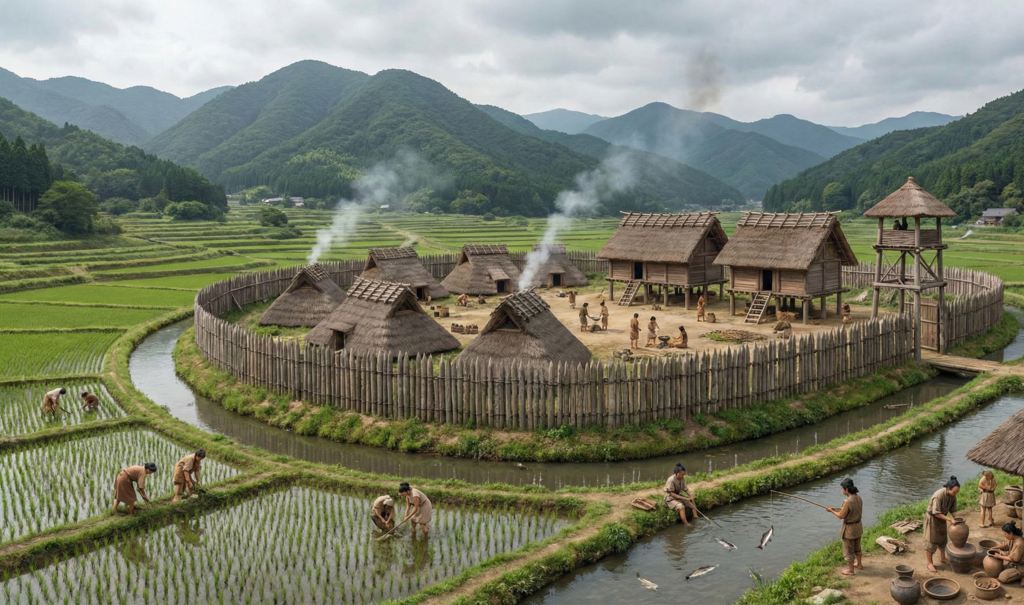
The Wet-Rice Lifestyle: The Jomon were semi-sedentary foragers. They were intensive agriculturalists. They reshaped the landscape, building irrigation canals and paddy fields. This ability to produce surplus food led to a population explosion. While the Jomon population had been declining, the population soared, allowing them to genetically swamp the native inhabitants.
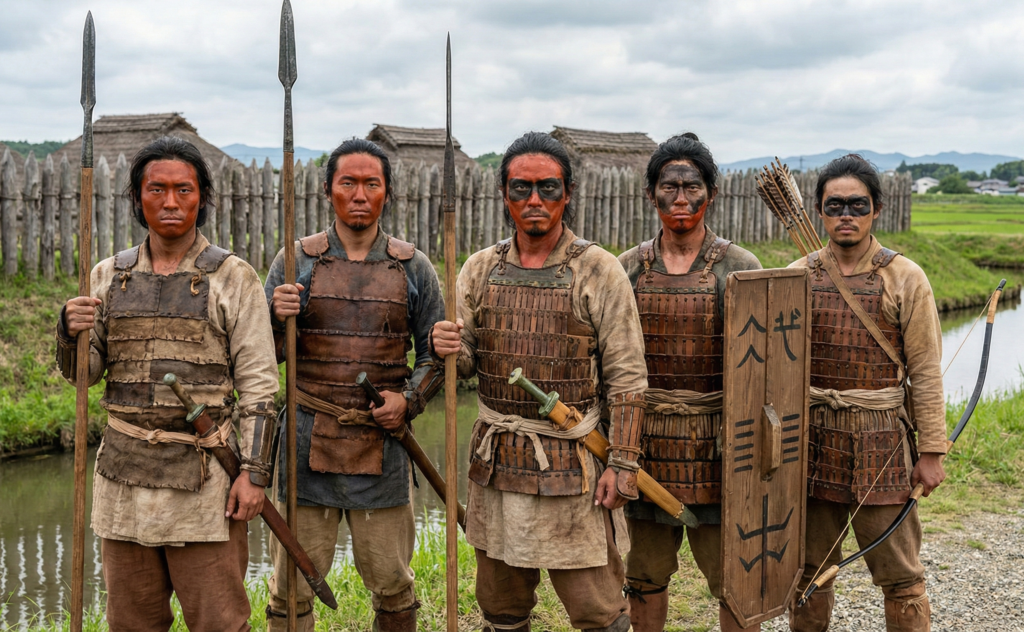
Metalworking: The Yayoi leapt past the Stone Age directly into the Metal Age. Uniquely, they introduced bronze and iron simultaneously. They used bronze for ceremonial items (like dotaku bells and mirrors) and iron for tools and weapons. This technological superiority gave them a massive advantage over the stone-tool-wielding Jomon.
Social Stratification: With stored rice came wealth, and with wealth came war. Yayoi settlements were often moated villages (kangō shūraku), built for defense. This era saw the rise of the first petty “kings” and the political consolidation that would eventually lead to the Yamato state.
3. The Genetic Profile: The Yellow River Connection
What did a Yayoi person look like genetically? Modern ancient DNA analysis has revolutionized our understanding of their origins.
For decades, the “Dual Structure Model” proposed that modern Japanese are a mix of Jomon and Yayoi. This is true, but we now know exactly what the Yayoi were.
The “Yellow River” Admixture: The Yayoi were not a single tribe; they were part of a massive movement of agriculturalists stemming from Northeast Asia. Their genetic profile is modeled as a mixture of:
- Yellow River Farmers (~60-70%): This is the core component. These people originated in the Yellow River basin of China (and the West Liao River). They were the first millet and rice farmers of Northeast Asia. As they expanded, they moved into the Korean Peninsula and then to Japan.
- Amur River/Northeast Asian Hunter-Gatherers: As the farmers moved north and east, they mixed with local populations in Manchuria and Korea before crossing to Japan.
When you look at Yayoi ancestry, you are looking at a genome that is distinctively Northeast Asian. It is characterized by adaptation to cold (EDAR gene variants leading to thicker hair and specific dental traits) and lighter skin, distinct from the darker-skinned, deep-featured Jomon.
The Modern Mix: A modern mainland Japanese person is essentially a “Yayoi” genome with a 10% to 15% “Jomon” spice thrown in. This small Jomon percentage is what makes the Japanese genetically distinct from their closest neighbors, the Koreans.
4. Haplogroups: Tracing the Migration Path
If you have used dna raw data upload services like NexoGENO, you can look at your haplogroups to trace this migration. The Yayoi brought specific lineages that define the modern Japanese population.
Paternal (Y-DNA) Lineages
- Haplogroup O1b2 (formerly O2b): This is the quintessential “Yayoi” marker. It is found at high frequencies in Japan and Korea, but is rare elsewhere. It likely originated in the Korean Peninsula or Northeast China and expanded rapidly into Japan with the rice farmers. If you have this marker, your male line arrived with the Yayoi.
- Haplogroup O2 (formerly O3): This is the most common haplogroup in Han Chinese and is also found in Korea and Japan. It represents the deeper “Yellow River” agricultural expansion.
- Contrast with Jomon: The Jomon carried Haplogroup D1b (D-M55). This is still found in 30-40% of Japanese men, proving that while the Yayoi culture dominated, the Jomon men were not wiped out; they were assimilated.
Maternal (mtDNA) Lineages
- Haplogroup A: Common in Northeast Asia, Korea, and Japan.
- Haplogroup B: Associated with the expansion of agriculture across the Pacific and East Asia.
- Haplogroup D4: The most common mtDNA lineage in modern Japan (and Korea). It is a classic Northeast Asian marker associated with the Yayoi expansion.
- Haplogroup N9a: Another marker linking Japan to the Korean Peninsula and China.
5. Answering the Hard Questions: Yayoi Identity
The origin of the Japanese people is a topic often clouded by nationalism and politics. Genetics, however, offers a neutral and clear picture. Let’s answer the most common questions.
Are Yayoi Korean?
Genetically, they are extremely close cousins. The Yayoi migrants entered Japan via the Korean Peninsula. During the Yayoi period (c. 300 BC), the population of the southern Korean peninsula and the population arriving in Kyushu were genetically almost identical. Modern Japanese and Modern Koreans are genetic siblings. The primary difference is that Japanese people have a significant (10-15%) admixture from the indigenous Jomon, which Koreans lack. So, while the Yayoi came from the direction of Korea, they formed the distinct Japanese population by mixing with the natives.
Are Yayoi Chinese?
Ancestrally, yes, but distantly. The ultimate origin of the Yayoi package (farming, genetics) lies in the Yellow River and West Liao River basins of ancient China. The people who became the Yayoi split from the ancestors of the Han Chinese thousands of years ago. They migrated north and east, evolving into a distinct Northeast Asian population (in Korea and Manchuria) before moving to Japan. They share deep ancestry with the Han Chinese (Haplogroup O), but they are not “Chinese” in the modern sense.
Are Yayoi Japanese?
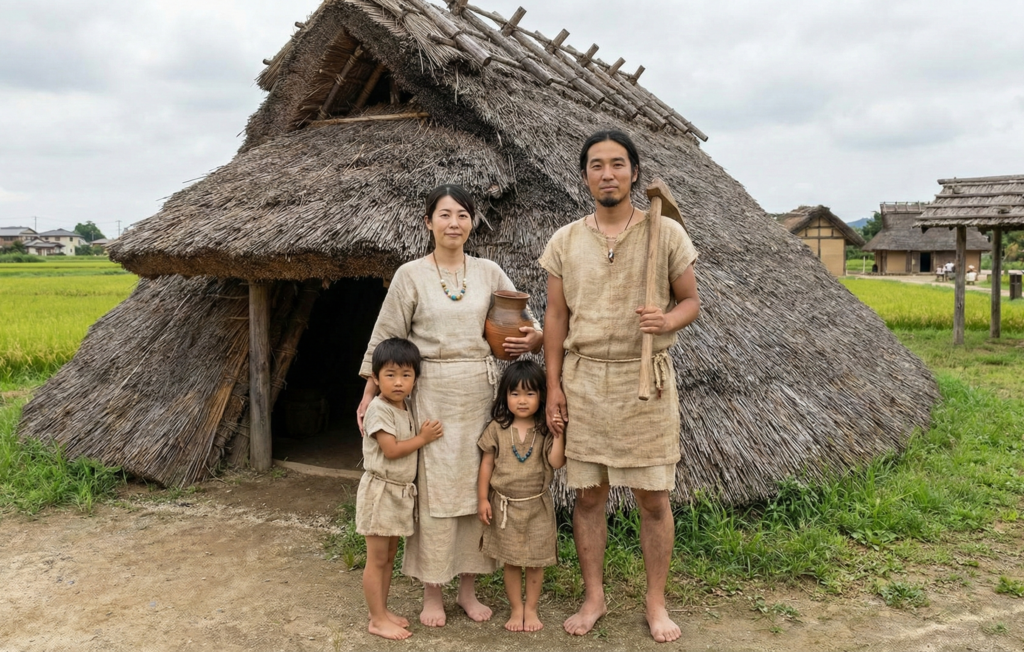
They are the “Base” of the Japanese. “Japanese” as an ethnicity is a fusion. The Yayoi provided the language (Proto-Japonic likely arrived with them), the agriculture, and the majority of the DNA. However, without the Jomon mixture, they would just be continental Northeast Asians. It is the fusion of the Yayoi and Jomon on the archipelago that created the unique Japanese ethnicity we know today.
6. What Can I Do With My Raw DNA Data?
Many people take a test with 23andMe or Ancestry and see a result that simply says “Japanese: 100%.”
For someone interested in history, this is boring. It doesn’t tell you the story of your ancestors. It doesn’t tell you if you lean more toward the ancient Jomon hunter-gatherers or the Yayoi rice farmers.
This is why you need to ask: where can i upload my dna?
The NexoGENO Solution: By performing a dna raw data upload to NexoGENO, you can unlock a deeper analysis.
- Ancient Admixture: We can compare your genome to ancient samples from the Yayoi period and the Jomon period.
- Regional Breakthroughs: We can see if your DNA aligns more with the Ryukyuan profile (higher Jomon) or the Continental/Tsushima profile (higher Yayoi).
- Haplogroup Detail: We analyze your Y-DNA and mtDNA to see if you carry the lineages of the indigenous islanders (D1b) or the continental migrants (O1b2).
Standard tests smooth over these differences. NexoGENO highlights them.
Conclusion: The Golden Age of the Archipelago
The Yayoi period was the dawn of civilization in Japan. It was a time of immense change, where the quiet forests of the Jomon gave way to the bustling, organized energy of rice farming societies.
The Yayoi people were resilient pioneers. They crossed dangerous seas, adapted their farming techniques to a new climate, and forged a new people. They are not just ancient history; they are the living biology of modern Japan.
If your DNA results point to Japan or Korea, you are the heir to this migration. You carry the legacy of the Yellow River farmers and the brave seafarers who bridged the gap between the continent and the islands.
Don’t settle for a generic label. Your history is a dramatic clash of cultures—the Hunter and the Farmer—and the result is written in your genes.
Unlock Your Asian Ancestry
Where can I upload my DNA? You can upload your raw data directly to NexoGENO.com.
We specialize in deep ancestry and paleo-genetics. Let us compare your DNA against the specific ancient populations of East Asia to see how much of the Yayoi legacy lives in you.
Discover if you have Yayoi genetics by uploading: https://nexogeno.com/our-products