
Your DNA Results Are Just the Beginning: Why You Need to Upload Your Raw DNA Data
You did it. You joined the millions who have asked, “where can i get a DNA test done?” You spit in a tube, sent it off, and waited weeks for that exciting email. Your DNA test results are in and you can download your raw DNA data.
You open the page and see a colorful pie chart. 50% “European,” 20% “West African,” 10% “East Asian,” and 20% “Broadly…”
It’s fascinating, but also… vague. What does “European” even mean? Does it connect you to the genetic communities in the Iberian Peninsula or the Slavic Balkans? What about “West African”? Does that mean Yoruba, Fulani, or Mandinka? And “Broadly” feels like a digital shrug. Your ethnicity estimate gave you a continent, but you wanted a country. You wanted your people.
This is the hidden secret of consumer DNA testing: the initial test is just the first step. The real, granular story—the one that goes beyond modern borders and connects you to specific, distinct heritage groups living today—is hidden inside your raw data file.
To unlock it, you don’t need a new test. You just need to know where can i upload my dna. By choosing to upload raw DNA data to a specialized service, you transform that vague “European” percentage into a detailed map connecting you to specific, modern populations.
Welcome to the next generation of genetic discovery.
The Problem with Modern Borders: Why Your Ethnicity Estimate Is Too Broad
The primary reason your initial DNA test results are so broad is that most major testing companies compare your DNA to modern reference populations. But even then, they often group them into overly broad “buckets.”
DNA doesn’t respect modern political borders. The genetic makeup of someone from the Iberian Peninsula (Spain and Portugal), for example, is a complex tapestry. A simple “Spanish” label doesn’t just fail to capture this complexity; it ignores it.
History is a story of migration, and while the events are in the past, the genetic results are visible in the present. The borders of Germany & France have been drawn and redrawn countless times. Their populations are not two distinct blocks; they are a genetic gradient. When you get a 30% “German & French” result, what does it represent? Does it mean you have roots in Paris, or in the Black Forest?
This is where a simple ethnicity estimate falls short. It can’t differentiate between the Northern Italy genetic signature, which shows different influences than the Central & Southern Italy signature. These are not historical curiosities; these are measurable genetic differences between modern populations today.
To get the real story, you need to break past these broad, continental labels and look at the distinct heritage groups that form the “ingredients” of your ancestry.
The Solution: The Modern Ancestry & Haplogroup Report
This is precisely why we developed the Modern Ancestry & Haplogroup Report. This isn’t just another pie chart. It’s your foundational report for uncovering your roots through over a hundred distinct modern populations.
When you upload your raw DNA data to us, we don’t just give you a continent. We analyze your genetic markers against a far more granular dataset.
Here’s what to expect from this deep dive:
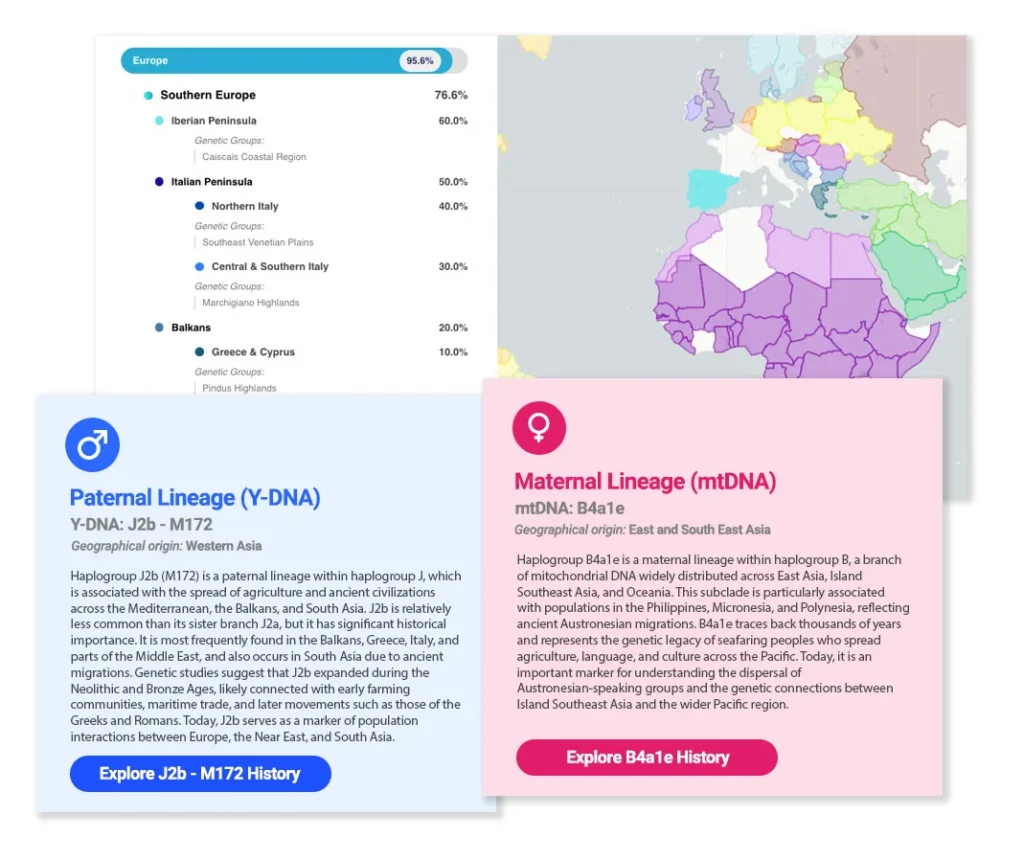
“Your genetic journey starts here: Discover your ethnic origins and haplogroups in detail. Our foundational report for uncovering your roots through over a hundred distinct populations. The Modern Ancestry Report breaks down your ethnic makeup into broad regions (e.g., Southern Europe, West Africa, East Asia) and then shows which specific heritage groups, such as the Iberian Peninsula, Levant & Mesopotamia, Yoruba-related groups, and Han Chinese subgroups, contribute to each percentage. You’ll also see your paternal and maternal haplogroups, with concise notes on their likely origins and ancestral migrations. This report gives you enough detail to intrigue you about your ancestry, with precision.”
This report provides enough detail to truly intrigue you about your ethnicity estimate, all with scientific precision.
A World of Peoples: Beyond the Continents
The true advantage of a granular test is seeing the incredible diversity of human populations today. When you upload raw data DNA, you’re no longer just “Asian”; you are connected to a specific history, a specific migration, and a specific people.
Let’s explore some of the fascinating heritage groups (from our list of over 100) that your report can reveal.
The European Mosaic
The Baltic States (Lithuania, Latvia, Estonia): Often grouped with “Eastern Europe,” these populations tell a different story. Genetically, Lithuanians, in particular, represent one of the most distinct genetic profiles in Europe, serving as a sort of “island” that saw less genetic mixture than some of its neighbors.
- Iberian Peninsula: This isn’t just “Spanish.” This signature is a unique modern blend. It connects you to the distinct genetic groups found across Spain and Portugal. Our analysis can help distinguish roots within this peninsula, which is genetically diverse from north to south.
- Italy (North vs. South): A single “Italian” label is a disservice to the country’s genetic diversity. Our report can distinguish Northern Italy, which shares more genetic similarities with neighboring Germany & France, from Central & Southern Italy, which has a different genetic profile reflecting its position in the Mediterranean.
- British Isles (England, Scotland, Wales, Ireland): This is one of the most requested areas. A broad “British & Irish” result is unhelpful. Our system breaks this down, identifying distinct genetic signatures for populations in England, Ireland, Scotland, and Wales. You can finally see if your “British” heritage is more Scottish or more English.
- Ashkenazi Jewish: This is a classic example of a “genetic population.” Despite living in Poland, Russia, Germany, and Ukraine for centuries, the Ashkenazi Jewish population’s shared heritage created a distinct genetic signature that is easily identifiable and points to a shared ancestral origin.
The Cradle of Diversity: Africa
Africa has the highest level of human genetic diversity on the planet. A label like “West African” is as broad as calling someone “Eurasian.”
- Yoruba and West Africa: Our report can connect you to specific large linguistic and ethnic groups, such as the Yoruba-related peoples of Nigeria and Benin. This provides a clear, specific connection to a people and a culture, rather than a vague spot on a map.
- North African Berber: The indigenous peoples of North Africa, the Berber (or Amazigh), have a genetic history distinct from the Arab populations. Their DNA connects modern people in Morocco, Algeria, and Tunisia.
- Guanche (Canary Islands): A fascinating outlier, the Guanche are the aboriginal inhabitants of the Canary Islands. Our analysis can identify this unique genetic signature, which is related to North African Berber populations but has been genetically isolated for an extended period.
- Egypt & Northeastern Africa: This region is a modern genetic bridge. The Egyptian profile is a complex layer cake, distinct from its neighbors, showing millennia of connection between the continents.
The Vastness of Asia
- Levant & Mesopotamia (Lebanon, Syria, Iran & Iraq): This region is home to dozens of distinct ethnic and genetic groups. A person from Lebanon & Jordan may show a different profile than someone from Iran & Iraq. Our report can identify signatures related to modern populations in the Levant, as well as Kurdistan and Turkey.
- China & Hong Kong: “Chinese” is an incredibly broad term. The Han Chinese are the world’s largest ethnic group, but they are not a monolith. Our analysis can show connections to specific Han Chinese subgroups, revealing a north-south genetic cline that reflects the country’s immense diversity.
- Japan & Korea: While geographically close, Japanese and Korean populations are distinct. The Japanese profile is a unique mixture reflecting the populations that settled the islands, while the Korean genetic profile shows deep roots on the peninsula, connecting them to other peoples in the region.
- India and Pakistan: This single region contains perhaps the most complex genetic diversity in the world, with thousands of distinct ethnic and caste groups. Our report can begin to unravel this complexity, pointing to specific regional ancestries within this vast subcontinent.
The First Peoples: Americas & Oceania
- Amerindian Ancestry: We can move beyond “Native American.” Our report can show connections to specific regional groupings, such as Mexican Native populations, Peruvian & Bolivian Native groups (connected to the Andean peoples), and Northern Amerindian peoples of the USA and Canada.
- Australian Aboriginal: Representing one of the oldest continuous cultures on Earth, the Australian Aboriginal genetic signature is a profound link to the people of that continent.
- Polynesian Peoples (Hawaii, Tahiti, Samoa): The peopling of the Pacific was a great human migration. From a starting point in the Pacific, seafaring peoples set sail, eventually reaching Vanuatu, Tonga, Samoa, and the most remote corners of the globe, including Hawaii Native populations. This incredible journey is etched in their modern DNA.
Your Deepest Ancestry: What Are Haplogroups?
The Modern Ancestry & Haplogroup Report gives you two reports in one. The ancestry portion tells you about your ethnic mix from the last few thousand years. The haplogroup portion tells you about your deep ancestral journey over tens of thousands of years.
Your product description says it best: you will see “your paternal and maternal haplogroups, with concise notes on their likely origins and ancestral migrations.”
- Maternal Haplogroup (mtDNA): This is your deep maternal line, passed from mother to child (both male and female). It traces an unbroken line of “mother’s mother’s mother’s…” back through time, following a migratory path from its origin.
- Paternal Haplogroup (Y-DNA): This is your deep paternal line, passed only from father to son (only males have it). It traces your “father’s father’s father’s…” line, following its own distinct migratory path across the globe.
Your haplogroups are your “genetic clans.” They tell the long-view story of your lineage, a powerful complement to your more recent ethnicity estimate.
The Process: How to Unlock Your Full DNA Story
So, how do you get this report? The process is simple and answers the two most common questions: “where can I get a DNA test done?” and “where can I upload my DNA?“
Step 1: Get Your Initial DNA Test. If you haven’t already, you must first get a test from one of the major autosomal testing companies (like 23andMe, AncestryDNA, MyHeritage, etc.). This is the “key” to the car.
Step 2: Download Your Raw DNA Data. Once your DNA test results are in, log in to your provider’s website. Find the “Settings” or “Browse Raw Data” section and look for the “Download” button. This will save a .zip or .txt file to your computer. This file contains the millions of genetic markers that we will analyze. It is your data.
Step 3: Upload Raw Data DNA to NexoGeno. This is the final and most important step. You take that raw data file and upload your DNA directly to our secure server. We then run your data through our advanced analysis.
Instead of a vague chart, you get the Modern Ancestry & Haplogroup Report. You get the fine-toothed-comb analysis, the specific heritage groups, and the deep ancestral haplogroups that your original test provider didn’t show you.
The Scientific Foundation
This level of granular detail isn’t guesswork. It’s built on decades of public-access scientific research in the field of population genetics. Large-scale academic projects, like the Population Reference Sample (POPRES) and the 1000 Genomes Project, have mapped the subtle genetic differences between modern populations worldwide.
For example, a landmark 2008 study in Nature by Novembre et al., “Genes mirror geography within Europe,” famously showed that when modern European DNA samples were plotted on a graph, their genetic positions mirrored the map of Europe. An “Italian” sample was genetically distinct from an “Iberian” one, which was distinct from a “Slavic” one.
Further research, such as the 2009 Science article by Tishkoff et al. on African genetic diversity, reinforced this. The study revealed the immense genetic variation within modern Africa, identifying 14 distinct ancestral population clusters. This is the science that allows us to move beyond “African” and identify connections to specific groups like the Yoruba.
By using these and hundreds of other academic studies on modern populations, our report is built on a foundation of rigorous, peer-reviewed science.
HOW MUCH DOES A MODERN ANCESTRY & HAPLOGROUPS TEST COST?
This is the best part. You already paid for the expensive part: the initial test. You own the raw data. Because you are simply uploading a file you already have, you are not paying for a new kit, new shipping, or new lab processing.
You are only paying for the advanced analysis itself.
To get your full, detailed Modern Ancestry & Haplogroup Report, the cost is only $29.90.
For less than the price of a dinner out, you can transform your vague ethnicity estimate into a rich, detailed story of your true origins. You can discover your connections to the modern Basques, the peoples of Siberia, or the distinct communities of Ireland and Scotland.
Where can I upload my Raw DNA Data?
You can upload your raw DNA data on www.nexogeno.com
Conclusion: Don’t Settle for a Vague Answer
Your DNA is a living history book. Your initial DNA test results gave you the table of contents. But the chapters—the specific regions, the distinct communities, the clear connections—are waiting to be read.
Don’t settle for “50% European.” Find out if that means Finnish, Balkan, Northern Italian, or Welsh. Don’t settle for “20% West African.” Discover your connection to the Yoruba or other specific groups. Don’t settle for a simple pie chart. Uncover your deep ancestral journey with your maternal and paternal haplogroups.
The answers to who you are and where you come from are already in your possession. You just need to know where to look.
Upload your raw data DNA today and discover the story that only you can tell.