
The Caucasus, known as the “Mountain of Tongues,” is a staggering crossroads of humanity. Wedged between the Black and Caspian Seas, this formidable mountain range has acted as both a bridge and a barrier, connecting Europe, the Middle East, and the Asian steppe. For millennia, it was a place of myth and legend—the land where Prometheus was chained, the destination of Jason and the Argonauts.
Today, however, the myths are giving way to data. A revolution in ancient DNA analysis is peeling back the layers of history, revealing the true genetic origins of the powerful peoples who forged civilizations, empires, and nomadic confederations in this complex region.
This isn’t just a story of one people, but a mosaic of many. We can now trace the genetic fingerprints of the first great Bronze Age cultures, the legendary kingdoms of the Iron Age, and the vast warrior hordes that thundered across the plains. Let’s explore the genetic legacy of five of the most significant ancient peoples of the Caucasus.
1. The Kura-Araxes Culture: The Bronze Age Innovators
Origins: The Kura-Araxes culture was a civilization that exploded onto the scene in the Early Bronze Age, around 3400 BC. Originating in the valleys of the Kura and Araxes rivers (in modern-day Armenia, Georgia, and Azerbaijan), they were masters of metallurgy and creators of a distinctive, polished black-and-red pottery that is found across the ancient world.
Dispersal: This was not a minor local culture. The Kura-Araxes people expanded massively, pushing south into the Levant, west into Anatolia, and north across the Caucasus. They represent one of the most significant migratory events of the Bronze Age, bringing their technology and, critically, their genes with them.
Ancient DNA & Haplogroups: The genetic story of the Kura-Araxes people is one of local roots. They are largely descended from the preceding Chalcolithic (Copper Age) peoples of the region, who themselves were a mixture of local Caucasus Hunter-Gatherers (CHG) and Anatolian Neolithic farmers.
- Paternal (Y-DNA) Haplogroups: Studies on Kura-Araxes sites, such as the 2019 paper by Wang et al. in Science, have identified a diverse mix of paternal lineages, primarily J1-Z1842, J2a-M410, G2a-L156, and T1a-P77. These are haplogroups deeply associated with the “Fertile Crescent” and the Caucasus.
- Maternal (mtDNA) Haplogroups: Their maternal lines are just as foundational, with common haplogroups including H, U, T, and K, all of which are common across West Eurasia.
Modern Descendants: The Kura-Araxes people are a foundational “substrate” for many modern populations. Their ancient DNA is a major component in modern Armenians, Georgians, and Azerbaijanis, and their genetic legacy is felt as far south as the Levant.
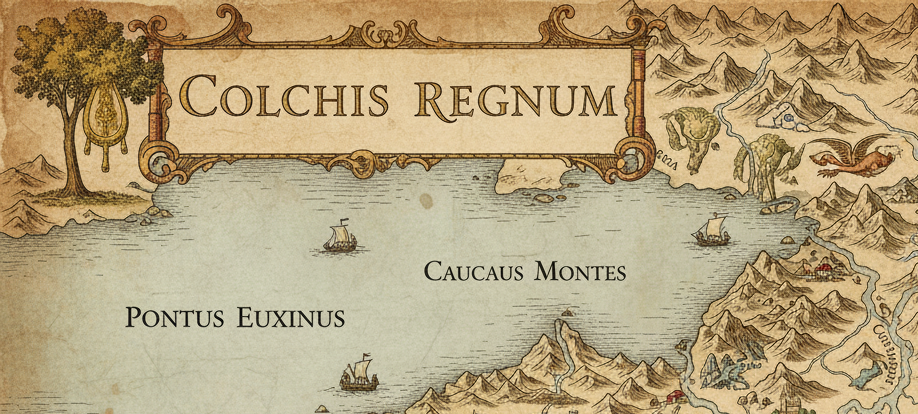
2. Colchis Georgia: The Land of the Golden Fleece
Origins: When we ask, “where is Colchis today?” we are pointing directly to the heart of western Georgia. Colchis Georgia was an Iron Age kingdom that emerged in the 13th century BC on the coast of the Black Sea. This is the legendary land from Greek mythology, the wealthy destination of Jason and the Argonauts in their quest for the Golden Fleece.
Dispersal: Colchis was not a migratory empire but a powerful, centralized kingdom. It was a hub of trade, rich in gold and iron, and a sophisticated society that minted its own coins. They were the successors to the local Bronze Age cultures, likely direct descendants of Kura-Araxes-related peoples who settled the coastal region.
Ancient DNA & Haplogroups: While ancient DNA samples from the Colchis elite are still being studied, we can infer their genetic makeup by looking at the deep genetic continuity in the region.
- Paternal (Y-DNA) Haplogroups: Modern Western Georgians (the descendants of the Colchians) show an extremely high frequency of Y-DNA haplogroup G2a (specifically G-M201). This lineage is considered a “native” Caucasus haplogroup, tracing its roots in the region back thousands of years to the first Neolithic farmers.
- Maternal (mtDNA) Haplogroups: The maternal lines are also distinctly “Caucasian,” with a high prevalence of haplogroups U1, K, and T, as well as unique subclades of W and X.
Modern Descendants: The Colchian genetic legacy is the bedrock of the modern Western Georgian people. Their DNA is a story of profound continuity, a testament to a people who have inhabited the same mountain valleys and coastal plains since the Bronze Age.
3. The Scythians: The Rulers of the Steppe
Origins: The Scythians were a different beast entirely. They were not settled farmers but a vast confederation of nomadic warrior tribes who emerged in the Iron Age, around the 9th century BC. Originating in the Central Asian steppes, they thundered west, eventually dominating a massive territory from the Black Sea (north of the Caucasus) all the way to the Altai Mountains in Siberia.
Dispersal: The Scythians were the definition of mobility. They were master horsemen and archers, and they dispersed their genes as rapidly as they conquered territory. They frequently raided south into the Caucasus, clashing with the empires of the Middle East.
Ancient DNA & Haplogroups: The genetics of the Scythians tell a fascinating story of a “genetic bridge” between East and West. A 2017 study in Nature Communications (Unterländer et al.) provided a stunning look at their DNA.
- Paternal (Y-DNA) Haplogroups: The dominant paternal lineage among the Scythians was R1a, specifically the “eastern” subclade R1a-Z93. This is a classic Indo-European “steppe” lineage, which they spread far and wide. Other lineages like Q (of Central/East Asian origin) were also present.
- Maternal (mtDNA) Haplogroups: Their maternal lines were a dramatic mix of West and East Eurasian lineages. They carried Western haplogroups like H, U, and T, but also Eastern haplogroups like A, C, and G. This confirms they were a highly admixed, mobile population.
Modern Descendants: Scythian DNA was not lost; it was absorbed. It is a major component in modern Eastern Europeans (Ukrainians, Poles, Russians), Central Asians, and, of course, peoples of the North Caucasus.
4. The Sarmatians: The Armored Nomads
Origins: The Sarmatians were another nomadic confederation who followed the Scythians, emerging from the southern Urals and the steppes east of the Caucasus. They were closely related to the Scythians, speaking a similar language, but were genetically and culturally distinct. They were famous for their heavy cataphract (armored) cavalry and the prominent role of their warrior women, who may have inspired the Greek myths of the Amazons.
Dispersal: From the 3rd century BC, the Sarmatians began to displace the Scythians, conquering the Black Sea steppes and becoming the new power that the Roman Empire had to contend with. They pushed deep into the North Caucasus and even settled in Roman territories.
Ancient DNA & Haplogroups: Genetically, the Sarmatians were also a West/East mix, but with a different flavor. A 2018 study in Current Biology (Krzewińska et al.) showed that while they were related to the Scythians, they had a stronger “western” pull.
- Paternal (Y-DNA) Haplogroups: Like the Scythians, they carried R1a-Z93, but also showed significant levels of I2a and R1b, suggesting greater admixture with European populations.
- Maternal (mtDNA) Haplogroups: Unlike the Scythians, their maternal lines were overwhelmingly West Eurasian (U, T, H, J), with very little of the East Asian admixture seen in the Scythians. This suggests their origins were from a more western steppe population.
Modern Descendants: The Sarmatians’ genetic legacy is strong in the North Caucasus, particularly among the Ossetians, who claim direct cultural and linguistic descent from them. Their DNA was also absorbed into the gene pools of modern Slavs and other Eastern Europeans.
5. The Artashesian (Artaxiad) Dynasty
Origins: The Artaxiad Dynasty (or Artashesian) was not a broad culture but a specific royal house that forged the Kingdom of Armenia in 189 BC. This dynasty didn’t just rule a random territory; it consolidated the Armenian people, who had just spent centuries forming from a mixture of local Bronze Age cultures (like the Kura-Araxes) and incoming Iron Age peoples.
Dispersal: The Artaxiads ruled over a people whose genetic profile had just “solidified.” A groundbreaking 2015 study in Nature (Haber et al.) revealed the genetic history of the Armenian people. It found that the modern Armenian genetic profile was created during the Bronze Age, when different populations (local Neolithic/CHG + new arrivals) mixed. After 1200 BC (the Bronze Age Collapse), this mixture stopped, and the Armenian gene pool has remained remarkably stable and isolated ever since.
Ancient DNA & Haplogroups: The genetic profile of the people ruled by the Artaxiads is the genetic profile of modern Armenians.
- Paternal (Y-DNA) Haplogroups: The Armenian paternal landscape is dominated by lineages such as R1b-L584 (a very specific “Armenian” branch, unrelated to the common West European R1b), J2a, and G2a. These are lineages with deep roots in the Armenian Highlands.
- Maternal (mtDNA) Haplogroups: A rich diversity of West Eurasian lines, including H, U, K, J, and T, reflecting their deep and ancient maternal origins in the region.
Modern Descendants: The Artaxiad Dynasty ruled over a people who are the direct and largely unmixed ancestors of modern Armenians.
How Can I Discover My Caucasian Ancestry?
This complex and powerful history is not just locked in the past; it is written into the DNA of people living today. If you have roots in Europe, the Middle East, or Central Asia, there is a strong possibility that your own DNA carries the echo of these ancient peoples.
But how can you find out? You don’t need a new, expensive DNA test. If you have already tested with a major company, you can use your raw DNA data.
How much does an ancient ancestry test cost?
This is the best part. You can unlock this deep history for a surprisingly low price. At NexoGeno, you can upload your existing raw data and get a full Ancient Ancestry Report that compares your DNA to these very populations—the Kura-Araxes, Scythians, Sarmatians, and more.
The cost for this powerful analysis is just $15.
Conclusion: The Living Past
The Caucasus is not a monolith. Its genetic history is a tale of two types of peoples: the deep-rooted, settled farmers of the mountains like the Kura-Araxes and Colchians, and the dynamic, mobile nomads of the steppe like the Scythians and Sarmatians.
These ancient cultures were not evolutionary dead ends. They were powerful, successful, and resilient. They survived, mixed, and migrated, and their genetic legacies are woven into the fabric of hundreds of modern populations.
Are you ready to find out if you have a connection to these legendary peoples? Discover your ancient ancestry at: https://nexogeno.com/product/ancient-ancestry-report/