
Beyond the Map: How Ancient DNA Analysis Is Rewriting Human History
If you’ve ever taken a commercial DNA test, you’ve probably seen a pie chart. You’re 25% “Italian,” 10% “Scandinavian,” and 55% “British.” It’s fascinating, but it’s also a snapshot of the very recent past, based on modern populations living within borders that are, in the grand scheme of things, brand new.
But what if you could go deeper? What if you could trace your lineage not just to a modern country, but to the Visigoth warriors who settled in Iberia? Or to the Etruscan civilization that thrived before the rise of Rome? What if you could find your genetic echoes in ancient Roman DNA or see your connection to the trade routes of the ancient Phoenicians?
This isn’t science fiction. This is the world of ancient DNA analysis, a revolutionary field that is moving beyond simple genealogy and into the realm of paleogenetics. It’s not just about building a family tree; it’s about understanding the epic, branching story of our entire species. An ancient DNA test isn’t just a map; it’s a time machine. And the story it tells is one of constant migration, mixture, and the profound reality that ancient dna and human history are one and the same.
Welcome to the real story of your ancient ancestry.
What Is Ancient DNA Analysis (And Why Isn’t It in Your Basic Test)?
First, let’s clear up a common confusion. The test you take from a major provider is an autosomal DNA test. It’s brilliant at finding second and third cousins and giving you that pie chart of “ethnicities” from the last 500-1,000 years. It works by comparing your DNA to modern reference populations.
An ancient DNA test is a different beast entirely.
This field, known as paleogenetics, involves the high-tech work of an ancient DNA laboratory. Scientists extract and sequence the degraded genetic material from the teeth and bones of humans who lived thousands of years ago. These aren’t reference panels of modern people; these are the actual genomes of ancient peoples.
When you get an ancient ancestry DNA report, you’re not just being matched to “Italians.” You’re being matched to specific archaeological cultures and historical civilizations. This ancient DNA analysis of human populations is a comparative process. Your genome is compared, marker by marker, to these ancient samples to see how much of your genetic makeup you owe to each of these foundational groups.
Instead of a vague “Hunter-Gatherer” label, you are matched with specific groups like:
-
- Ancient European Civilizations: Such as the Mycenaeans of Greece, the Etruscans and Roman Latini of Italy, or the Iberian Tartessians.
-
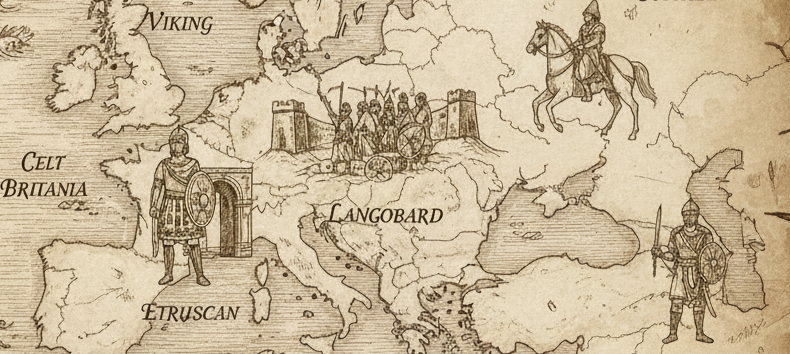
- Migration-Era Peoples: The tribes that redrew the map of Europe after Rome’s fall, like the Visigoths, Langobards (Lombards), Saxons, and Vikings.
-
- Ancient Near Eastern Empires: The people who built the first cities and empires, like the Hittites, Assyrians, Babylonians, and Persians.
-
- Foundational African Populations: The builders of the Nile Valley civilizations, such as the Ancient Egyptians and Nubians, or the Iberomaurusians of North Africa.
-
- Ancient Americas: The progenitors of great civilizations, including the Mayan, Andean, and other South Amerindian groups.
It’s a complete shift in perspective, moving from a static, modern map to a dynamic story of your people’s migrations.
The Advantages: Peering Thousands of Years into Your Past
So, why bother? What’s the advantage of knowing you’re 10% Etruscan or 5% Phoenician?
The advantage is context.
Your standard “Italian” result, for example, is actually a complex genetic recipe. An ancient DNA analysis breaks that recipe down. It shows you why you’re “Italian”—perhaps your ancestors are a specific mix of Roman Latini, Etruscans who were absorbed into the Republic, and Langobards who migrated there a thousand years later.
This deep-time perspective gives you a profound connection to history. You’re no longer just a passive observer of the past; your DNA becomes a living document of its greatest events.
-
- You can see the genetic legacy of the Roman Empire’s expansion and its collapse.
-
- You can trace the footprint of the Viking explorations.
-
- You can discover connections to the Harappan civilization of the Indus Valley or the Jomon hunter-gatherers of ancient Japan.
-
- You can understand that your ancient origins DNA is not from one place, but from a series of specific, named human migrations that shaped the world we live in.
This type of analysis isn’t just a novelty. It’s solving old historical debates. As geneticist David Reich of Harvard University states, the “genome revolution” has become an instrument for studying the human past as powerful as archaeology or linguistics.
A World Without Borders: Ancient DNA and Human Expansion
One of the most powerful lessons from ancient DNA analysis is that the modern borders we obsess over are utterly meaningless in the context of deep history. The idea of a “pure” genetic population is a myth. The story of humanity is a story of relentless movement, mixture, and ancient dna range shift demography expansion.
Before this technology, our understanding of prehistory was based on potsherds and linguistic theories. We assumed we knew who the Etruscans were or where the Celts came from. Ancient DNA is now providing concrete proof, often with surprising results.
The genetic history of Europe, for instance, is not a simple story. It’s a tale of empires rising and falling. The “Fall of Rome” was not just a political event; it was a massive demographic shift. Ancient DNA analysis allows us to track the genetic signatures of:
-
- The Goths (Visigoths): Moving from the Black Sea, through Italy, and finally settling in Roman Hispania.
-
- The Langobards: Migrating into Italy, leaving a distinct genetic layer on top of the existing Roman Latini and Etruscan-descended populations.
-
- The Saxons: Moving from mainland Europe into Britain, mixing with and partially displacing the native Insular Celts.
This isn’t just cultural change; it’s a measurable demography expansion. We can see the genetic trails of Scythian and Sarmatian nomads across the steppe, the sea-lanes of the Vikings, and the trade routes of the Phoenicians. Your DNA is a record of these colossal, continent-shaking events. There was no “Britain” or “Germany.” There was just a shifting landscape of tribes, migrations, and empires that laid the groundwork for the modern world.
Journeys of Our Ancestors: Analyzing Key Ancient Populations
This revolution in understanding isn’t limited to one region. Let’s look at some of the specific populations your keywords highlight, and see what the ancient DNA analysis has revealed.
Ancient European DNA: A Mosaic of Cultures
Instead of a simple “European” label, an ancient DNA analysis breaks it down into the specific peoples who formed the continent. We can see the legacy of the foundational Roman Latini people, and also the distinct Etruscan civilization they lived alongside and eventually absorbed. We can differentiate the Continental Celts (like the Gauls) from the Insular Celts of Britain (Celt Britania).
We can find the genetic traces of the Vikings (from regions like Jutland) who raided and settled from Russia to Canada. We can see the genetic impact of the Slavic peoples who expanded across Eastern Europe, and the unique profiles of groups like the Thracians and Dacians. This level of detail moves beyond simple percentages and into the realm of identity.
Ancient Egyptian DNA: The Nile Valley Nexus
The ancestry of the ancient Egyptians has been a source of intense debate. What did the data finally show?
A landmark 2017 study in Nature Communications (Schuenemann, et al.) provided the first genome-wide data from Egyptian mummies. They analyzed 90 mummies from Abusir el-Meleq, spanning 1,300 years from the New Kingdom to the Roman Period.
The finding was clear: the ancient Egyptian DNA showed that these individuals were most closely related to ancient populations from the Near East (the Levant) and Anatolia. They were not, as some had argued, a primarily Sub-Saharan African population.
Even more fascinating, the study showed that modern Egyptians have a significantly higher (8-15%) component of Sub-Saharan African ancestry than the ancient Egyptians. This gene flow, the authors conclude, happened after the Roman period, likely due to increased trans-Saharan trade routes. This is one of the clearest examples of ancestry DNA tests that show ancient Egyptian data correcting long-held assumptions.
Ancient Nubian DNA: The Crossroads of the Nile
Just south of Egypt lay the powerful kingdom of Nubia (in modern-day Sudan). Was it a separate genetic world, or an extension of Egypt?
A 2022 Nature Communications paper analyzed ancient Nubian DNA from individuals at Kulubnarti. The results showed that Nubia was precisely what its geography suggests: a genetic crossroads. The ancient Nubians had a mix of ancestry. A large part was local, similar to modern Sudanese populations (Paleo African lineages). However, they also carried a significant amount of West Eurasian ancestry, which the study notes was “likely introduced into Nubia through Egypt.” This paints a picture of the Nile as a two-way genetic highway, with people and genes (like Ancient Subsaharan African and Near Eastern) flowing both north and south for millennia.
Ancient Phoenician DNA: A Culture, Not a “Bloodline”
The Phoenicians were the master traders of the ancient world, spreading out from the Levant (modern-day Lebanon) to found colonies like Carthage in North Africa and settlements in Spain. Did they spread their genes just as widely?
Here, ancient DNA analysis delivered a stunning twist. A recent 2024/2025 study analyzing Punic (Phoenician) sites in places like Sardinia and Ibiza found that the people buried there had very little genetic ancestry from the Levantine homeland. Instead, their genetic profiles were much closer to the local populations: Aegeans, Sicilians, North Africans, and Iberians.
The takeaway is revolutionary: “Phoenician” was less of a shared genetic identity and more of a cultural and economic network that diverse peoples adopted. You could become Phoenician by joining their trade network, in a way that would be impossible to see without ancient Phoenician DNA.
Ancient Roman DNA: The Imperial Melting Pot
Rome. The capital of an empire of 70 million people. What did its citizens look like? A 2019 paper in Science answered this by sequencing 127 genomes from 29 sites in and around the city, spanning 12,000 years.
The ancient Roman DNA showed the city was a “genetic crossroads.”
-
- In its early days (the Iron Age), the people of Rome (Roman Latini) were genetically similar to other
Italians.
- In its early days (the Iron Age), the people of Rome (Roman Latini) were genetically similar to other
-
- But as the Empire grew, a massive wave of migration occurred. During the Imperial period, the data shows a huge influx of ancestry from the Eastern Mediterranean—Roman Anatolia, the Levant (Phoenicians, Hebrews), and Egypt.
The people walking the streets of Imperial Rome were incredibly diverse, with many having recent roots in the Near East. The Empire wasn’t just a political entity; it was a genetic melting pot that actively drew people from its farthest corners to its center.
Ancient Persian DNA: Continuity and Connection
The ancient Persian DNA story, from the heart of great empires like the Achaemenids, is one of stability. A 2025 study on the Iranian Plateau showed remarkable genetic continuity, tracing a core population back to local Neolithic farmers of the Zagros mountains.
But this stability was layered with connections. The Iranian Plateau was a hub, and its people (like the Kassites before them) show genetic links to South-Central Asia (Harappan), the Caucasus (Kura Araxes), and the West (Mesopotamian, Assyrian). This reflects its historical role as a bridge between East and West, a core population that absorbed and integrated newcomers over thousands of years.
Ancient Siberian DNA: The Gateway to Continents
For decades, we knew Native Americans descended from populations in East Asia. But ancient Siberian DNA revealed a much more complex story. The vast expanse of Siberia was a gateway and a homeland in its own right.
Ancient DNA analysis from Siberia has been crucial in understanding the peopling of the Americas, showing the deep ancestral links between Siberians and groups like Native USA, Native Canada, and South Amerindian populations.
But it also reveals deep connections across Eurasia, linking populations from the far east (like the Jomon or Yayoi of Japan and the Gojoseon of Korea) to the peoples of the West. It’s a critical component in understanding the full tapestry of human migration, including the genetic origins of groups like the Huns and Mongolians who emerged from the region to forge vast empires.
How Can I Find My Ancient Ancestry?
This is where the technology becomes personal. You don’t need to join an archaeological dig. Thanks to the power of ancient DNA upload services, you can use the raw data you already have from your consumer DNA test.
Here’s how it works:
-
- Download Your Raw Data: Log in to your existing DNA provider (like 23andMe, Ancestry, etc.) and download your raw DNA file (usually a .txt or .zip file).
-
- Find an Ancient Ancestry DNA Upload Service: Use a specialized service, like NexoGeno, that focuses on paleogenetics. This is crucial, as the major companies don’t offer this level of deep-time analysis.
-
- Upload and Analyze: Upload your DNA file on NexoGENO.com.Our service’s Ancient DNA Report wil takes your genetic data (your SNPs) and runs it against a massive database of published ancient genomes.
-
- Get Your Report: Instead of a pie chart of modern countries, you get a detailed report that breaks down your ancestry into these ancient civilizations. For example, your report might show:
-
- 35% Hittite
-
- 25% Mycenaean
-
- 20% Phoenician
-
- 15% Ancient Egyptian
-
- 5% Nubian
-
- Get Your Report: Instead of a pie chart of modern countries, you get a detailed report that breaks down your ancestry into these ancient civilizations. For example, your report might show:
This ancient DNA analysis provides the “why” behind your modern results, connecting you directly to the foundational populations that formed your deep ancestry.
How Much Does an “Ancient Ancestry” Test Cost?
This might be the best part. Because you are not paying for a new, expensive DNA collection kit and lab processing, the cost is minimal. You are simply paying for a highly specialized analysis of data you already own.
So, how much does an “Ancient Ancestry” test cost?
At NexoGeno, we make this powerful analysis accessible. You can upload your raw data from another testing company and unlock your deep past for just $15.
It’s a small price to pay to discover your connection to the ancient world. Ready to see your history?
Get your Ancient Ancestry Report at nexogeno.com today!
Where can I upload my raw DNA data?
You can upload your raw DNA data on www.nexogeno.com
Conclusion: Your DNA Is a History Book
The study of ancient DNA and human history has opened a new frontier. We are, for the first time, reading the past directly from the people who lived it.
What we’ve learned is that our history is not one of static, “pure” groups. It is a dynamic and chaotic story of migration, admixture, and relentless human expansion. The borders on our maps are fleeting, but the genetic echoes of the Etruscans, the Phoenicians, the Vikings, and the Roman citizens who came before us are written into our cells.
An ancient DNA test is more than a novelty. It’s a powerful tool for self-discovery that shatters modern myths and connects us to the single, vast, and interwoven family of humanity.
Are you ready to find out who you really are?
Follow Us On: Facebook, Instagram, Reddit