
Italy is not just a country; it is a genetic bridge. Stretching from the snowy peaks of the Alps to the sun-drenched center of the Mediterranean Sea, the Italian peninsula has been the stage for one of the most complex human migrations in history.
When we talk about the Italian Phenotype, we are not talking about a single “look.” We are talking about a vibrant mosaic. A walk through the streets of Milan offers a completely different visual experience than a walk through the markets of Palermo.
Why? because the Northern Italian Genetics and Southern Italian Genetics tell two different, yet interconnected, stories. One is a story of the continent, influenced by the Celts and Germanic tribes. The other is a story of the sea, influenced by the Greeks, the ancient Siculi, and the Near East.
If you have ever wondered why some Italians have blue eyes and fair skin while others have the classic olive complexion, the answer lies in the deep history of the peninsula. Today, we explore the stunning diversity of Italian beauty, the ancient tribes that shaped it, and how Nexogeno DNA can help you uncover which side of the bridge your ancestors stood on.
1. The Great Divide: Why North and South Look Different
To understand the Italian Phenotype, you must first understand the geography. The Apennine Mountains act as a spine, but the real genetic border has always been historical.
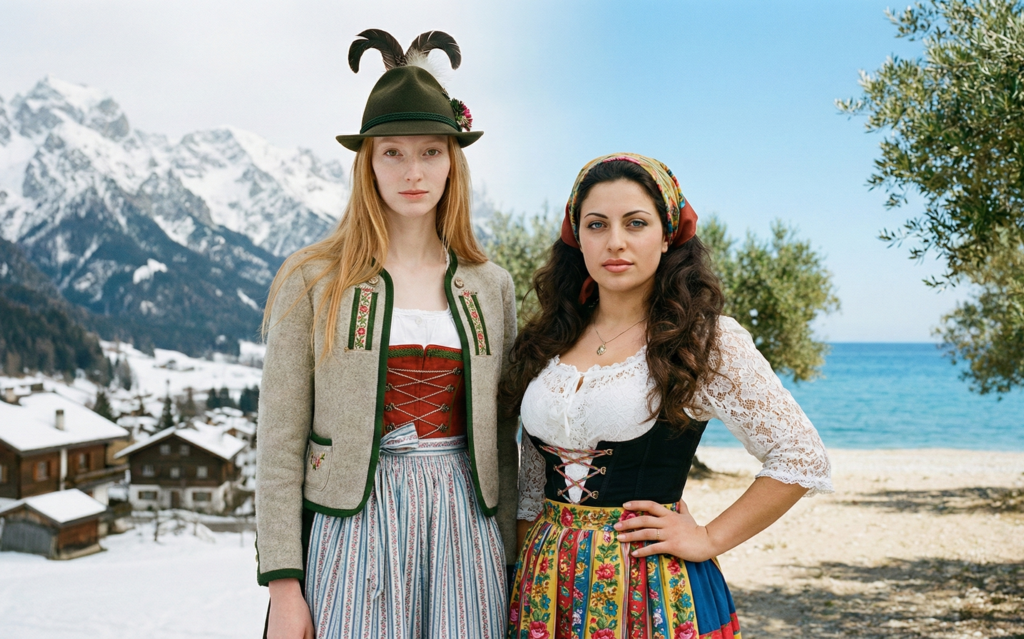
The Northern Influence (The Continental Pull)
Northern Italy (the Po Valley, Lombardy, Veneto, Piedmont) is geographically part of Central Europe. For millennia, this region was a highway for populations coming from the north and west.
- The Celtic Substrate: Before Rome expanded, Northern Italy was known as Gallia Cisalpina (“Gaul on this side of the Alps”). It was inhabited by Celtic tribes like the Insubres and Boii. This Celtic influence is a cornerstone of the Northern phenotype, contributing to lighter pigmentation and broader facial features.
- Germanic Admixture: Later, invasions by the Goths and, most importantly, the Lombards (Longobards), added a Germanic genetic layer, reinforcing traits like taller stature and lighter eye colors.
The Southern Influence (The Mediterranean Pull)
Southern Italy (Campania, Calabria, Sicily, Apulia) is the heart of the Mediterranean.
- The Siculi and Greeks: Sicily and the South were dominated by ancient Italic tribes like the Siculi, and later heavily colonized by the Ancient Greeks (Magna Graecia).
- The Mediterranean mix: This region served as a hub for Phoenicians, Arabs, and Normans. However, the foundational genetics remain deeply Southern European and East Mediterranean, creating a phenotype adapted to the strong sun and maritime lifestyle.
2. Deep Dive: The Northern Italian Phenotype
When looking at Northern Italian Genetics, the predominant physical type is often classified in older anthropology as “Alpine” or “Dinaric,” mixed with “Atlantid.”
Physical Characteristics:
- Stature: Generally taller than the national average. The influence of Continental European diets and genetics (Celtic/Germanic) has resulted in a taller skeletal build.
- Pigmentation: While dark hair is still common, there is a significantly higher frequency of lighter features. Light brown to dark blonde hair is not unusual.
- Skin Tone: Often “Rosy-Pale” or “Intermediate.” Northern Italians tend to burn before they tan, compared to their Southern cousins.
- Facial Structure: The “Alpine” influence often creates a rounder or broader face shape, with a nose that is less prominent than the classic Roman profile.
The Celtic Connection: The Celtic heritage in regions like Piedmont and Lombardy is not just a myth; it is visible. The presence of the MC1R gene variants (associated with red hair and fair skin) is higher in the North, a direct echo of the Iron Age Celtic tribes that founded cities like Milan.
3. Deep Dive: The Southern Italian Phenotype
The Southern Italian Genetics profile is the archetype of the “Mediterranean” beauty that made Italian cinema famous worldwide. Anthropologically, this is often the “Gracile Mediterranean” or “East Mediterranean” type.
Physical Characteristics:
- Stature: On average, slightly shorter and more gracile (slender-boned) than the North, though robust builds are common in regions with ancient gladiatorial stock.
- Pigmentation: Deep pigmentation is the norm. Hair ranges from dark brown to jet black.
- Skin Tone: This is the home of the famous “Olive” skin tone—a light brown hue that tans easily and deeply, a natural adaptation to the Mediterranean sun.
- Facial Structure: Features are often more defined. The nose can be straight or aquiline (the “Roman nose”), and eyes are often large and almond-shaped.
The Siculi and Greek Connection: The ancient Siculi were an Italic tribe that gave Sicily its name. Their genetics, combined with the massive influx of Greek settlers (who made Syracuse larger than Athens at one point), created a population that is genetically distinct from the North. If you have deep Southern roots, your DNA likely clusters closer to the Greek islands and Cyprus than to Switzerland.
4. Stature and Pigmentation: A Statistical Reality
The differences in the Italian Phenotype are not just anecdotal; they are statistical.
- Height: Historical conscription records from the 20th century consistently showed a height gradient. Conscripts from Friuli (North) were, on average, several centimeters taller than conscripts from Sardinia or Calabria (South). While modern nutrition has closed this gap, the genetic propensity remains.
- Eye Color: This is the starkest difference. In some Northern regions (like Veneto), light eyes (blue/green/hazel) can appear in 30-40% of the population. In the deep South and Sardinia, dark brown eyes are overwhelmingly dominant, present in over 70-80% of the population.
5. Answering Your Top Questions About Italian Looks
The Italian Phenotype confuses many people because Hollywood often portrays only one type. Let’s clarify the reality.
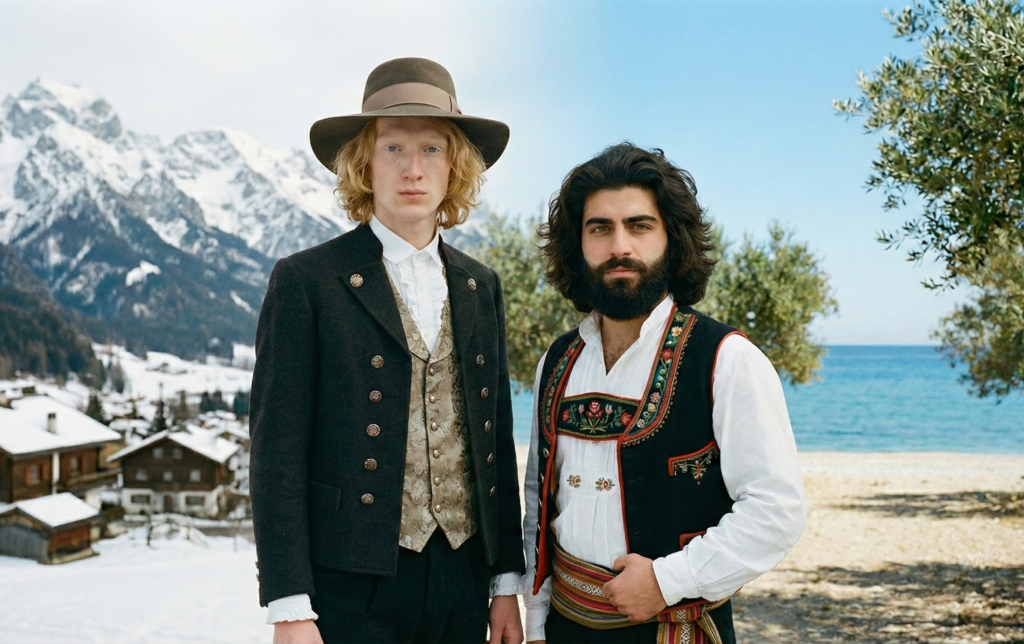
What are traditional Italian features? (North vs South)
- North: Broader faces (Alpine influence), intermediate to fair skin, lighter brown hair, taller stature. Think of the elegance of the Northern fashion hubs.
- South: More elongated or oval faces (Mediterranean influence), olive skin, jet black or dark brown wavy hair, large expressive eyes, darker eyelashes and eyebrows. Think of the classic “Mediterranean passion.”
What is Italian skin tone called? (North vs South)
- North: It is often called “Fair” or “Intermediate White.” It lacks the yellow/golden undertone found in the south and can look pinkish.
- South: It is famously called “Olive” (or Olivastra in Italian). This skin has a subtle greenish/golden undertone that protects against UV rays and tans to a rich bronze.
What are Italian female features? (North vs South)
- North (The Virna Lisi Type): Often characterized by finer features, lighter eyes, and a cooler complexion. The beauty standard here often leans towards a “Central European” elegance.
- South (The Sophia Loren/Monica Bellucci Type): Characterized by the “Femme Fatale” archetype: hourglass figures, dark voluptuous hair, full lips, and intense dark eyes. This is the global icon of Italian femininity.
What eye color is most common in Italians? (North vs South)
- Overall: Brown is the most common eye color in Italy.
- North: While brown is still #1, there is a very high minority of Hazel, Green, and Blue eyes. In the Alps, blue eyes are common.
- South: Dark Brown and Black-Brown are the predominant shades. Light eyes in the South are striking because of the contrast with darker skin, but they are statistically rarer.
6. Beyond the Mirror: Decoding Your Genotype
You can look in the mirror and see a nose shape or a skin tone, but phenotypes can be misleading. A person with blue eyes can have 90% Southern Italian Genetics, and a person with dark eyes can be 100% Northern.
The only way to know the truth is to look at the source code: your DNA.
Standard commercial tests often lump Italy into one broad category. They miss the nuance of the Siculi ancient tribes or the Celtic markers in Lombardy.
This is where Nexogeno Results shine.
Where can I upload my DNA? If you have raw data from Ancestry, 23andMe, or MyHeritage, you can upload your DNA to Nexogeno.
Nexogeno DNA analysis goes deeper. We use advanced algorithms to separate the peninsula. We can tell you if your genetic profile aligns with the:
- North Italian Cluster: Showing affinities with French, Swiss, and Central European populations.
- South Italian/Sicilian Cluster: Showing affinities with Greek, Cypriot, and East Mediterranean populations.
We don’t just look at modern borders; we look at the ancient haplogroups and autosomal patterns left behind by Celts, Greeks, and Romans.
Conclusion: A Masterpiece of Diversity
The Italian Phenotype is a masterpiece painted by history. It is not uniform, and that is its strength.
Whether you carry the lighter features of the Celtic-influenced North or the profound, sun-kissed features of the Siculi-influenced South, your look is a testament to thousands of years of survival, art, and migration.
Italy is a land where the blonde Germanic warrior met the dark-eyed Greek philosopher. Your face is the result of that meeting. But to truly understand the percentage of that mix, you need to go beyond the mirror.
Discover Your Roots
Are you Celtic-Alpine or Greco-Mediterranean?
Discover your Northern Italian Genetics or Southern Italian Genetics at: https://nexogeno.com/our-products/
Follow us on: Facebook – Instagram – Reddit
Read our article about the Northern Italian Genetics: https://nexogeno.com/northern-italians-are-they-really-italian/