
Spaniard DNA Results: 4 Remarkable Truths About Your Deep Spanish Heritage
What does it mean to have DNA from Spain?
For many, it evokes a simple image: a sun-drenched Mediterranean coast, flamenco, and a unified culture. But the spaniard dna results of the spaniard people tell a story that is infinitely more complex, ancient, and fascinating.
The Iberian Peninsula is not a simple monolith. It is a fortress, a crossroads, and a cul-de-sac. It is an Atlantic land, a Mediterranean land, and a European land.
Your DNA in Spain is a living chronicle of European hunter-gatherers, Middle Eastern farmers, Celtic warriors, Roman centurions and Germanic Visigoths, all clashing and merging on this one piece of land.
Today, we are unpacking four remarkable truths that define the spaniard people, from the blue-eyed hunter of La Braña to the modern genetic map shaped by the Reconquista. This is the ultimate guide to your deep Spanish heritage.
1. The Foundation: The “Original” Spaniard Had Blue Eyes
Before we can understand the spaniard people, we must meet their oldest known ancestor: La Braña Man.
In 2014, scientists sequenced the genome of a 7,000-year-old Mesolithic hunter-gatherer discovered in a cave in La Braña, in the Cantabrian Mountains of northern Spain. The results were revolutionary.
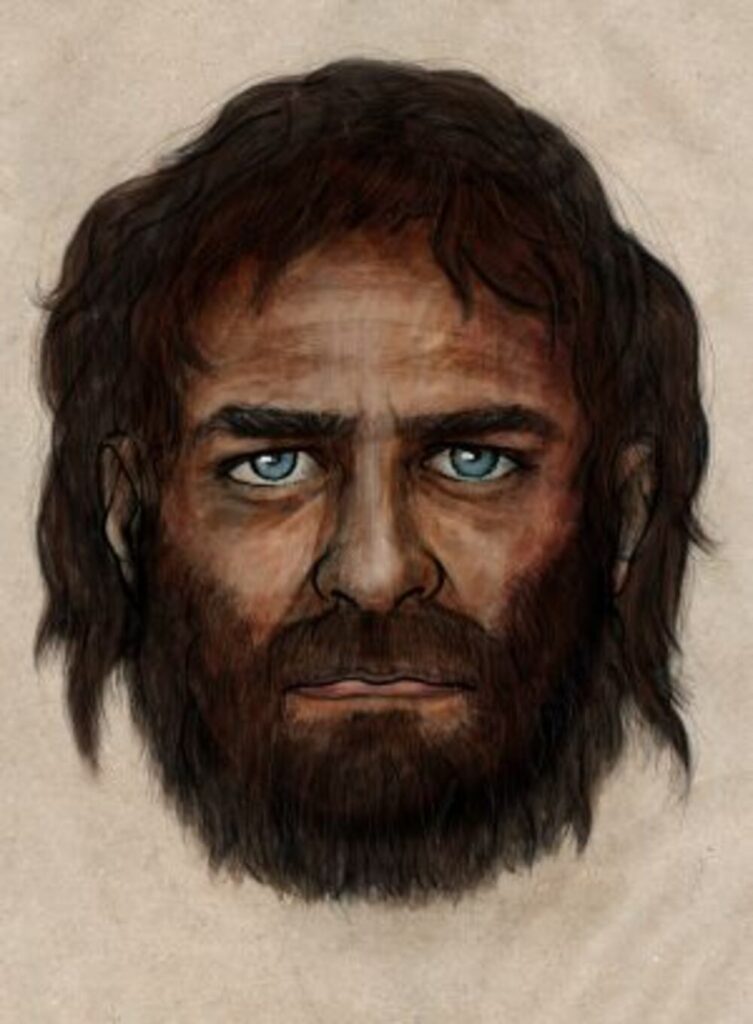
- He had dark skin: His genes showed a clear “brown” skin.
- He had blue eyes: He possessed the genetic variants that produce blue eyes, a combination (dark skin, blue eyes) that is almost non-existent in modern Europeans.
La Braña Man was a Western Hunter-Gatherer, the “native” European population before the arrival of agriculture. This is the deepest genetic layer dna in Spain is built upon. He was not an anomaly; he was the original Iberian.
This “native” population was soon joined by two great migrations that would form the basis of all Europeans:
- Neolithic Farmers: Arriving ~7,500 years ago from Anatolia (modern-Day Turkey), they brought agriculture, lighter skin, and genes for brown eyes.
- Steppe Pastoralists: Arriving ~4,500 years ago from the Pontic-Caspian Steppe (modern Russia/Ukraine), these “Yamnaya” people brought horses, Indo-European languages, and a new genetic signature that would dominate the continent.
These three groups (Hunter-Gatherers, Farmers, and Steppe peoples) are the foundational ingredients. But in Spain, the recipe of that mixture is unique.
2. The Basque Enigma: A Genetic Island in Western Europe
It’s impossible to discuss dna from Spain without talking about the Basques. The Basque people, who live in the western Pyrenees mountains between Spain and France, are a true genetic and linguistic marvel.
- Linguistic Isolates: Their language, Euskara, is a “language isolate.” It is not related to Spanish, French, or any other language on Earth. It is the last surviving pre-Indo-European language in Western Europe.
- Genetic Isolates: For decades, this linguistic mystery fueled genetic research. A landmark 2015 study in Science analyzed the genomes of ancient Basque skeletons and modern Basques. The results were stunning.
The Basques are direct descendants of the first Neolithic farmers who arrived in Iberia, mixed with the local La Braña-like hunter-gatherers. Crucially, they never received the large-scale influx of Steppe Pastoralist DNA that the rest of Spain and Europe did.
They are a “living fossil” population, a direct, unbroken line back to the Stone Age farmers of Iberia. This is why the primary East-West genetic pattern in Spain is defined by them. Basque-related ancestry is strongest in the West (in the Basque Country and Cantabria) and dilutes as you move east toward the Mediterranean, where more Roman and other migrations occurred.
3. The Great Genetic Divide: The Reconquista and the North-South Axis
While the Basque component defines an East-West pattern, the dominant genetic story in Spain is a North-South divide. This divide is not just geographic; it is the direct, living result of a 700-year war: the Reconquista.
The Moorish Invasion (711 AD) In 711 AD, a force of North African Berbers and Arabs (the “Moors”) crossed into Spain, defeated the Visigothic kingdom, and conquered nearly the entire peninsula. They established “Al-Andalus,” which would rule for over 700 years.
This was not just a political occupation; it was a demographic one. It brought a massive and sustained influx of North African DNA (primarily E1b1b haplogroups), which mixed with the local Hispano-Roman population. This genetic layer is a key component of what makes DNA from Spain distinct from the rest of Europe.
The Reconquista and Repopulation From their northern strongholds (like Asturias and the Basque Country), the small Christian kingdoms began to fight back. This 700-year struggle, known as the Reconquista, ended in 1492 when the last Muslim ruler was defeated in Granada.
This war created the North-South genetic cline we see today. Here’s how:
- The North (e.g., Asturias, Cantabria): This region was never fully or permanently conquered. It served as the “refuge” for the Christian kingdoms and received almost no Moors.
- The South (e.g., Andalusia, Murcia): This region was under Islamic rule the longest. It received the highest populations of Moors.
- The “Repopulation”: As the Christian kingdoms pushed south, they didn’t just conquer; they repopulated. The expelled Muslim and Jewish populations (Moriscos and Sephardim) were replaced by Christian settlers, mostly from the North of Spain, but also from other parts of Europe (like France).
4. The Spanish Haplogroups: A Unique Iberian Signature
When we look at spaniard dna results, we see a few key haplogroups (deep ancestral lines) that tell this story perfectly.
Paternal (Y-DNA) Haplogroups of Spain
- R1b-DF27 (The “Iberian” Marker): This is the single most dominant paternal haplogroup in Spain, found in over 40% of Spanish men (and peaking at 70% in the Basques). It is a branch of R1b, the haplogroup brought by the Steppe peoples. But DF27 is a unique “Iberian” branch that expanded rapidly within Spain during the Bronze Age. If you have this marker, you have a powerful link to the foundational peoples of Iberia.
- E1b1b (The North African Marker): This is the second most common lineage in many regions. It is the primary haplogroup of the North African Berbers. Its presence in Spain, almost non-existent in the Basque country but peaking in the South.
Maternal (mtDNA) Haplogroups of Spain
- Haplogroup H (The “Farmer” Marker): Like most of Europe, Haplogroup H is the most common maternal line in Spain (over 40%). It’s the great “farmer” lineage that arrived from the Near East 7,500 years ago.
- Haplogroup U (The “Hunter-Gatherer” Marker): This is the ancient lineage of hunter-gatherers like La Braña Man. Specifically, Haplogroup U5 is found at significant levels in Spain, especially in the North. It’s a deep, 10,000+ year-old link to the “original” Europeans.
Answering Your Top Questions About Spanish DNA
This complex history leads to a lot of common questions. Let’s answer them.
Are Spaniards White?
Yes. “White” is a modern social category, and Spaniards are Europeans. Genetically, they are a Southern European population, and they cluster firmly with other Europeans. The typical spaniard people phenotype is often stereotyped, but in reality, it is incredibly diverse.
What do Spaniards look like?
The “Mediterranean” stereotype (olive skin, dark hair, dark eyes) is only part of the story. Due to its diverse genetic inputs (Celtic, Visigothic, Steppe), Spain has incredible phenotypic diversity. You will find red-haired, blue-eyed Galicians; tall, light-skinned Basques; and olive-skinned, dark-eyed Andalusians. There is no single “Spanish” look.
Are Spaniards Latino?
No. This is the most common point of confusion, especially in the Americas.
- Latino refers to a person from Latin America (Mexico, Colombia, Brazil, etc.).
- Hispanic refers to a person from a Spanish-speaking country (Mexico, Colombia, and Spain).
Spaniards (from Spain) are Hispanic, but they are not Latino. They are Europeans.
Are Spaniards Mediterranean?
Yes and no. Geographically, half of Spain is on the Mediterranean. Genetically, they are a core part of the Mediterranean group, alongside Italians and Greeks. However, the northern coast (Galicia, Asturias, Basque Country) is an Atlantic coast, and its genetic profile is more similar to the Irish and French. Spain is both Atlantic and Mediterranean.
Are Italy and Spain related through DNA?
Yes, very much so. Spaniards and Italians are “genetic cousins.” Both countries are primarily descended from the same three ancient groups (Hunter-Gatherers, Neolithic Farmers, and Steppe peoples). They share ancient Roman heritage and cluster very closely on a genetic map. They are, however, distinct. The key difference is that DNA from Spain has the unique Basque genetic substrate.
Is there Celtic DNA in Spain?
Yes, absolutely. This is a key part of the spaniard dna results. Before the Romans, northern and western Spain were dominated by Celtic tribes known as the Celtiberians. The regions of Galicia and Asturias, in particular, have a powerful Celtic legacy, sharing cultural and genetic ties with other Atlantic Celtic nations (like Ireland, Scotland, and Wales).
How Much Does an Ancestry Test Cost?
Understanding your deep heritage is more accessible than ever. While many tests can be expensive, at NexoGENO, we believe in making this knowledge available.
A NexoGENO Modern Ancestry & Haplogroup Report costs just $29.90.
This report takes your raw DNA data and breaks down your modern ethnic percentages, connecting you to specific heritage groups and revealing your deep paternal and maternal haplogroups. It is the key to unlocking the complex layers—Celtic, Roman, Moorish, and more—that define your unique Spanish heritage.
Where can I upload my DNA?
If you have already tested with another company (like 23andMe, Ancestry, etc.), you don’t need to pay for a new kit. You already own your data. You can download your raw data file from their website and upload it directly to a specialized service to get a more in-depth analysis.
So, where can i upload my dna for the best Spanish breakdown? You can upload it at www.nexogeno.com.
Conclusion: Spain, The Resilient Crossroads
The DNA from Spain is a testament to resilience. The spaniard people are not a simple, single group. They are a profound and unique blend, forged by history.
They are the ancient, blue-eyed hunters of the mountains. They are the Stone Age farmers who became the Basques. They are the Roman legionaries, the Visigothic noblemen, and the Celtic warriors of the Atlantic coast.
A spaniard dna results is a window into a truly remarkable past. It is a story of a people who were not replaced, but who absorbed every wave of migration and conflict, creating a genetic signature that is uniquely, and proudly, Iberian.
Discover Your Modern Ancestry
Discover your modern ancestry at: https://nexogeno.com/our-products/